Showing posts with label #UofT #LearnerExperience. Show all posts

Tuesday, February 28, 2023

It’s me, hi, I’m the problem, it’s me

Originally published in edublogs, Writing for Learner Engagement. Part of the Class Home Room Blog from a course at the U of T. Posted under Always Something More to Learn, URL 

Quoting the incomparable Taylor Swift, Antihero

Sometimes it seems like I am the only one who worries about things. I have been excused of being antiquated and out of touch with technology. Am I the problem? If we circle back to my earlier post about Writing Being Under Attack, I wonder if we all really want to sound the same? In my opinion, part of communication is about the unique uses of language. How I might phrase something is completely different from how someone else might do it. Some of the things that make my writing unique are my purposefully negation of contractions, use of Canadian spellings, and my conversational academic tone, which aims for professionalism, but is also friendly, approachable, and polite. I am a firm believer in reading things out loud and triple checking before submitting or hitting send.

There are many useful tools that help us write. I have come to rely on spell and grammar checkers that are built into Word, PPT, and Outlook. Predictive text on my iPhone helps me craft a text with one hand while I pet my dog with the other. Having struggled with language arts as a younger child, I often feel at a significant disadvantage in the grammar department. Another compelling reason to incorporate writing aids.

Yet what happens when we let artificial intelligence “correct” our work or even “write for us”. Think for us, do the work for us. Do we analyze the text, or trust the machine? As someone who has been in the work world for decades, I feel like I have a strong foundation of knowledge. I recognize potentially fraudulent information, incorrect use of terminology, information that does not make sense, or lacks evidence. What happens to those who are entering post-secondary education or the work world. Do they have this same discretion? Do they question what they find online, or are they easily swayed by a provocative headline? Is this true? Here is an article on the rampant spread of misinformation on social media.

Case in point, here is an example from an email that I sent out earlier today. I was wondering if the individual had a preference for date and time when we should meet.
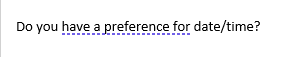
The editor in Outlook wanted to change this to ‘Do you prefer date/time?’ Without a list of options, this does not make sense.

So, what is the solution? Be discerning. Verify information from multiple sources. Trust reliable sources. Trust your instincts, and find your own voice. Use evidence to back up your opinions. Not sure about a grammatical rule, double check on Google. Use the tools, but also learn from them.


Always Something More to Learn

Originally published in edublogs, Writing for Learner Engagement. Part of the Class Home Room Blog from a course at the U of T. Posted under Always Something More to Learn, URL

  1. How did you find the last assignment to create a job aid, reference guide or infographic? What this a useful challenge, and something you see yourself leveraging in future?
    • Writer’s block, well perhaps more like topic block. I wanted to create something that I could repurpose for work, but I have too many projects on the go and had trouble determining what would be a good topic for this purpose. I finally landed on a handout on active learning strategies. I wanted to update the handout with different strategies, so I thought it made a good candidate for a complete redesign.
    • In my work, we do create a lot of handouts, or SharePoint pages with instructions on how to complete a task. Brevity is key, so this assignment was very useful because it forces you to concentrate on the most important points. No one wants to look at an infographics that is just text.
  2. Reflect back on your prior assignments and blog posts in this course. What have been some highlights? What would you say are the key techniques or ‘aha moments’ you experienced that have influenced how you will approach writing for your audiences going forward?   
    • I was surprised to see so many connections between developing curriculum and writing. So many elements are similar, like writing engaging titles and powerful introductions, chunking materials into manageable pieces, the importance of organization and placement of materials, and creating meaningful content that people want to read.
    • Some important takeaways for me are writing concisely, alternating paragraph length, breaking up text through the use of other elements (bulleted lists, images, text boxes, etc.), and engaging your audience. So many things that apply not only to my writing, but also my teaching. Again, I was surprised to see so many connections.
  3. How do you feel about writing now vs. when you started this course seven weeks ago?
    • Writing was a chore, but now it is fun again. I enjoyed exploring topics that were outside of my purview, hoping to engage my audience and provide a compelling reason why we should care about these issues. So maybe that is it – learning to write persuasively.
  4. Action Plan – What are 1-3 ideas or actions you would like to commit to in order to continue the development of your writing skills?
    • Concentrate on art and design elements while ‘presenting’ my written works.
    • Practice, practice, practice. That is the only way to improve.
    • Focus on writing for online curriculum.

Thursday, February 16, 2023

What's the point?

Originally published in edublogs, Writing for Learner Engagement. Part of the Class Home Room Blog from a course at the U of T. Posted under Always Something More to Learn, URL

I tend to write longer, block paragraphs of text. My style includes a wall of text. I struggle between being direct, getting straight to the point, vs. being verbose, but perhaps with a friendlier tone.

Because of this, one of my strategies for writing email is to capture the key point first, and then go back and add some of the filler. The part of the message that makes it more personalized, welcoming, more authentic. 

My first step is to highlight key messages, especially points that I think will be confusing. Here’s an example for a recent email that I sent to a group of learners. In the email, I had embedded a poll that is built into Outlook. I assumed that many of my leaners would have never used it before. Figuring out what to click on is a bit confusing. 

Here’s the email text:

I have created a poll for our next session. You have two options:

  • If you can attend on March 1st at 3:30, then ignore
  • Not available or would prefer to attend at another time, respond to the poll. Click on 3 options to vote in the poll below.
Because of the yellow highlighter, these two points should be the very first thing that the learner sees when they open the email. It is also helpful with email to put the action item in the subject line.

Vote now! Options for our next meeting.

Really? You expect me to read all of this?

Originally published in edublogs, Writing for Learner Engagement. Part of the Class Home Room Blog from a course at the U of T. Posted under Always Something More to Learn, URL

Faced with a wall of text are you: a) thrilled, b) overwhelmed, c) anxious, or d) already tired. 

40 minute Mr. Beast video - sure no problem. Sequel to a long awaited series, yes please, who needs sleep. Favourite fan fic, I got the time, bring it on. All of these are definitively A. Capital A - thrilled!

Other options including course curriculum. B, C, and/or D. These walls of text will have learners reacting with dread. Case in point, clicking on one of the suggested resources for this week, my immediate reaction was "ugh, do I really have time to watch the whole thing". Even though, everything that I have read/watched/listened to thus far in this class has been extremely valuable. I know that. I know that I will learn a lot, but 84 minutes is a commitment. 

So if you are not Mr. Beast, how do you engage your learner? How can you entice them to read, learn, and participate in your course. Several solutions were presented this week. And in case you were wondering Kristi, I did read all of them. Here are some of the suggestions that stood out to me. 

  • Include a summary at the beginning of the article. See 7 Golden Rules for an example. This reminds me of abstracts in scholarly research. It gives the reader a compelling reason to continue reading, answering the WIIFM. 
  • Organization is critical. That includes the placement of items on the page, their proximity to one another, and avoiding redundancies. 
  • Chunk information. Add white spaces. Shorten paragraphs. Use bullet points or numbered lists for key pieces of content. These act as memory aides. 
  • Substance vs. gloss. Shiny and pretty might be visually appealing for the reader, but if there is no substance, it can be very frustrating. For more information, check out this great article

Course materials that appeal to both visual and verbal elements of learning will aide in engagement with the content and retention. This can be achieved by providing a variety of resources and types of materials. Better yet, by providing options, you are meeting UDL principles. 


Friday, February 3, 2023

Redo or Start Over

Originally published in edublogs, Writing for Learner Engagement. Part of the Class Home Room Blog from a course at the U of T. Posted under Always Something More to Learn, URL

What is easier? To redo someone’s existing work, or to start over. Sure it is nice to have something to start with. Someone else has done all of the work. All you have to do is tweak it and make it better. But that can also be painful. Sometimes I get stuck in their language. I can’t think of any other way to say it.

If you start from scratch your voice is present throughout. The piece follows your stream of consciousness. The words, phrases, and information are your personal choices. Disadvantage here is that you might not know how to start, or what to say.

I am struggling with the first assignment, trying to rewrite someone else’s copy. Last year was spent the same way. I rewrote an existing course and made it into something new. I also created a new course from scratch. In the end, both are good courses, but I am extremely proud of the one that I created on my own. This one also didn’t take as long to complete. Interesting. I should spend some time thinking about that.

Peer Reviewer 2 is the Worst

Originally published in edublogs, Writing for Learner Engagement. Part of the Class Home Room Blog from a course at the U of T. Posted under Always Something More to Learn, URL

Rejection is a huge part of academic writing.

But let’s step back a bit and review how one would even get to this point. It starts with an idea. Perhaps it is a gap that your institution is trying to address. Perhaps you are investigating a solution for a problem that you can no longer ignore. You invest your time and energy into this project. You read literature. You experiment, interview, survey, explore. You pour your heart and soul into it. The project is huge, so you work with a team, over a period of six months to several years. You write up your research findings in the form of an academic journal article. You are filled with hope. You have produced something that people will want to read. It is important. You scour academic journals to find one that is appropriate to publish your piece in and then you hit submit. You are optimistic. If you make it past the first editorial review, your paper is then forwarded to a group of three peers who will complete a double blind peer review of the piece (i.e.: you don’t know who they are, they don’t know who you are). Your excitement begins to wane.

Peer review has three outcomes. The first and most rare result is that the article is accepted upon first review, with no changes. Second, tentatively accepted with minor/major changes. Or third, and the most likely scenario is that your article will be rejected. Regardless of the outcome, you will receive feedback.

Every time that I have went through this process I have learned a great deal and my writing has been the better for it. If you are lucky, at least one of the reviewers will be thorough, making suggestions throughout the text. From minor grammatical errors, to word choice, to areas that require further explanation, are vague, or should be deleted all together. Then it is back to the drawing board. Your team will need to decide how to incorporate all of the “helpful suggestions” into the work. You are allowed to disagree, but you will need a compelling reason why. You submit it again and hope for the best. Maybe if you are lucky this time, the journal will run the piece. You now move to copyediting, which thankfully is a lot easier. When the final product is published, you often do not recognize it. You have this feeling of “did we write that, it is actually really good”. The editors and reviewers made it so.

But back to reviewer 2, the reviewer who is notorious for making unhelpful suggestions. Don’t believe me, Google it. Titles include “How bad is reviewer 2, really?”, “How not to be reviewer 2” and “How did the myth of reviewer 2 come to be”. For some reason they have earned themselves a horrible reputation, and it is not hard to find many author reflections on how terrible this reviewer is. In my experience, they give you nothing of value. No explanation why they think your piece is not suitable nor are there any suggestions for improvement. So ignore reviewer 2, and concentrate on the other feedback. Even better, cement this knowledge into your brain. Use it in the future. Writing is an iterate process. Learn as you go.

So why did I choose to focus on peer review in this blog post? Because the process recognizes the importance of editing. And what have I learned in module three? I am committing the ultimate writing sin. I am writing and editing at the same time. I am author, editor, and peer reviewer all in one. I am not spewing all of my ideas onto the page, and then returning later to edit. When did I realize that I was doing this? Paragraph three. At that point, I forced myself to just start typing, regardless of polish. Let’s repeat that – paragraph three, not several years ago, not at the beginning of this module, but paragraph three. Why? Well before this class, I honestly never thought about the process too much. It was just what I did.

Now. I have the inevitable blank stare at the screen – what do I actually want to say?

I wonder what comments reviewer 2 will have, if any?

Writing is Under Attack

Originally published in edublogs, Writing for Learner Engagement. Part of the Class Home Room Blog from a course at the U of T. Posted under Always Something More to Learn, URL
What is it about human nature, that we immediately go to doom and gloom when faced with change. ChatGPT was introduced, and suddenly social media is flooded with posts about the end of the university essay; posts heralding that research papers are now obsolete; some even suggesting that education is antiquated. Writing is dead is the same argument that they tried to use when calculators were invented – no point in learning math any longer (I wish).
Perhaps we fail to remember that overhauling post-secondary education has been on our agenda for a while now. That we have been slowly transitioning to authentic assessments in order to ensure that knowledge gleaned is actually applicable when our learners enter the work force. That independent thought has power, impact, and value. Despite not seeing a relevant reason for essay writing, the connection is evidence. Learning how to use evidence to frame our ideas, helps us to form compelling arguments. You may not write essays in your real life, but you do need to know how to be persuasive, how to make a point, how to debate, how to discuss, how to be logical and reasonable. All of these skills are learned through essay writing and research papers.
We have also forgotten the humanist angle. There is only one person in the world that has had the same experiences as I have had, me. There is only one person in the world that has my perspective, my knowledge, and my opinions. All of that is meaningful. My contributions matter. Writing is a very powerful way to communicate thoughts, ideas, learning, opinions, and points of view.
So before you start the inevitable doom scroll, don’t forget that you have a voice.
Use it.